Vendor data cleansing
A. Vendor master data
Vendor master data, also known as supplier master data, is a record of key vendor information, It includes general data such as the vendor name and address, company code data, payment transaction data, purchasing data, Payment terms, transaction currency. It is a centralized, digital repository containing essential, accurate, and up-to-date information about a company's suppliers.
Vendor master is a centralized database of information regarding company suppliers. That single database can aid both accounts and purchase departments fetch and managing suppliers information easily.
Vendor master data is typically managed by the accounting team and the procurement or purchasing team.
B. Key components
| Vendor Code | Unique code for each vendor |
| Vendor Name | The official name of the vendor |
| Vendor Type | Manufacturer/Distributor/Service provider |
| Address | Physical location of the vendor |
| Contact details | Phone number, Email id's |
| Finance information's | Banking and tax information's |
| Payment terms | Terms and conditions |
| Lead time | Time required for the vendor to deliver product/services |
C. Challenges in vendor master data management
| Challenges | Descriptions |
|---|---|
| Inconsistent data | Conflicting data |
| Incomplete data | Missing information's |
| Duplicates | Duplication in vendor code creation |
| Lack of Classification | UNSPSC, SIC, NAICS etc |
| Decentralized data creation | Creation of vendor master from multiple BU's without SOP's |
| Lack of Governance | Poor governance results errors, inconsistency |
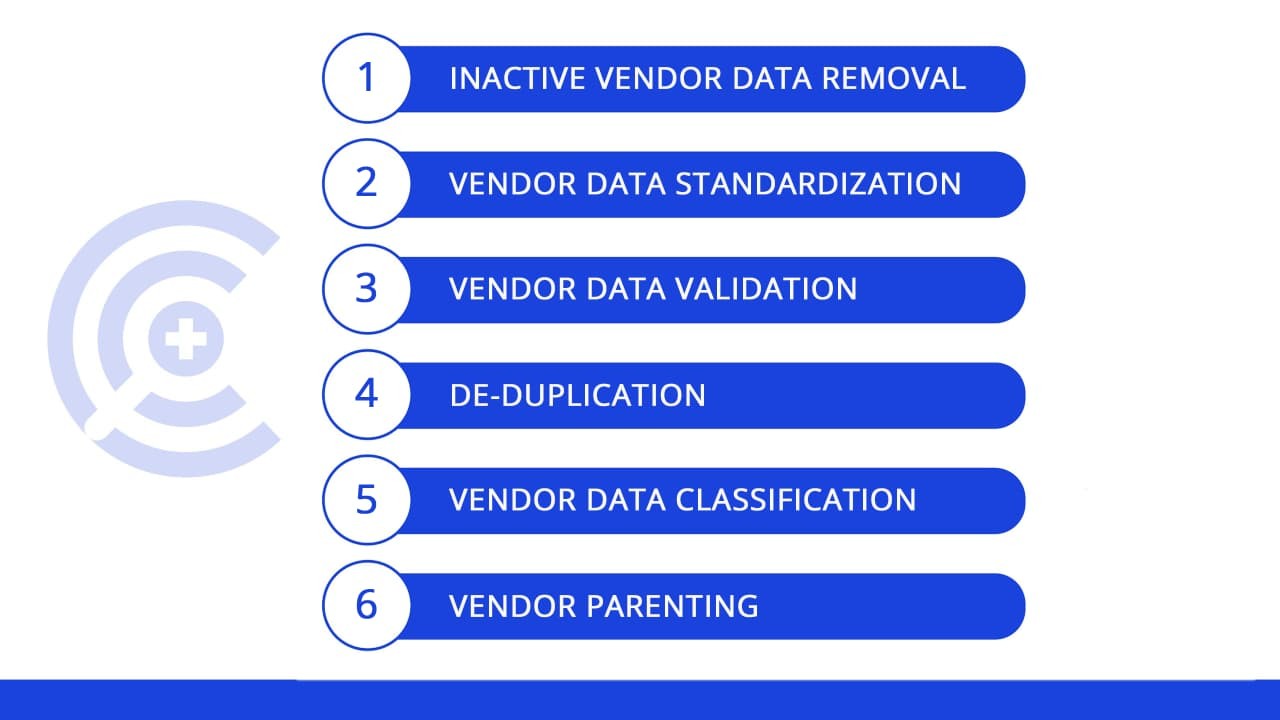
D. Vendor data cleansing & classification
1. Inactive vendor data removal: Identify and block the vendors with no activity for 12 to 48 months. This minimizes the risk.
2. Vendor data standardization: Apply consistent formatting for vendor master data key components such as Vendor name, Vendor type, Address, Contact details, Finance information's etc
3. Vendor data validation: Verify Tax ID’s, Contact details, Banking information’s
4. De-duplication: Using matching algorithms, Match the vendor records and merge them into a single record to prevent duplicate invoices.
5. Vendor data classification: Classification is the process of grouping the vendor master data with the help of a. classification taxonomy. Most widely used classification system is UNSPSC-United Nations Standard Products and Services Code (UNSPSC) is a global, hierarchical classification system used to categorize products and services for e-commerce, procurement, and spend analysis. It uses a 4-level (or 5-level) structure—Segment, Family, Class, Commodity, and Business Function—represented by 8 or 10 digits to enable standardized reporting and tracking. Apart from UNSPSC, Organizations also use Custom taxonomies.
6. Vendor Parenting: Identify Parent-Child or Hierarchy based relationships between vendors to understand total spend across corporate groups.
E. How Primezerve can help
Primezerve, specializes in Master data cleansing & governance software solutions that enable organizations to build excellence in Procurement and supply chain controls, Plant maintenance efficiency. With powerful tools like PrimeMDG® to help organizations manage and cleanse their Vendor master data. These platform provide automated data harmonization, Data Cleansing & Enrichment, AI Powered data classification, Duplicate detection, Seamless integration with ERP/EAM Systems for governing the vendor master data.